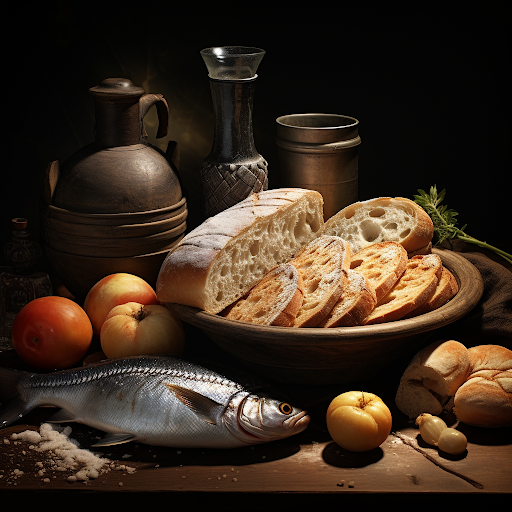
The Bread and Fish
(Matthew 14:13-21, 15:32-39, Mark 6:30-44, 8:1-10, Luke 9:10-17):
Jesus multiplied a small amount of bread and fish to feed thousands. This miracle illustrates God's abundance and how He can meet our needs, no matter how little we have.

Setting
The story of the Bread and Fish unfolds against the backdrop of ancient Galilee, a region teeming with life. It was a place where vast crowds gathered, seeking solace in the teachings of Jesus. His words and actions had stirred hearts and minds, drawing people from near and far. The shores of the Sea of Galilee bore witness to the curious, the faithful, and the hungry, both in body and spirit.
In the shadow of rolling hills and under the warm embrace of the Middle Eastern sun, this story began. The setting was serene yet bustling, as people yearned to be near the man whose words spoke of hope, love, and compassion. The story, however, would take a miraculous turn, leaving an indelible mark on the hearts of those who bore witness.
Introduction
As the story commenced, Jesus stood by the Sea of Galilee, surrounded by a vast multitude. Among them were the sick, the troubled, and the hungry. They had travelled from near and far, drawn to Jesus like moths to a flame. His words had kindled a fire of hope and faith that warmed their hearts, but their physical hunger gnawed at their bodies.
News had spread like wildfire that this man, Jesus, had the power to heal and perform miracles. As the day wore on, the sun began to dip below the horizon, and the disciples grew anxious. The people, thousands in number, were hungry, and there was nothing to feed them. In this moment, as the crowd’s physical hunger mirrored their spiritual thirst, the story of the Bread and Fish took an extraordinary turn.
Revelation
The revelation in this story was one of profound significance. As the disciples brought Jesus a meagre offering of five loaves of bread and two fish, it was clear that, in human terms, this was not nearly enough to feed the multitude. Jesus showed that even small offerings can be abundant in God’s eyes.
As he took the bread and fish, he lifted his eyes to heaven, acknowledging the source of all abundance. The revelation was that the Creator of the universe, the one who had made the heavens and the earth, could take the simplest of provisions and multiply them beyond imagination.
Turning Point
The turning point in this story was when Jesus, holding the meagre offering of bread and fish, began distributing it among the multitude. The turning point was not just a demonstration of Jesus’ miraculous powers; it was a turning point in the hearts and minds of those present.
The loaves and fish fed everyone with plenty to spare. This turning point, a moment of abundance from scarcity, had profound implications. It was a turning point in perception, understanding, and the capacity to believe in the limitless nature of God’s provision.
Life Lesson
The life lesson of Bread and Fish is one of immeasurable value. It teaches that human notions of scarcity do not confine God’s abundance. It illustrates that even when we have little to offer, what we have can be multiplied to meet the needs of many.
The story reminds us that our limitations do not bind God’s provision. It is a lesson that instils faith, not just in the miraculous but in the boundless nature of God’s love and care for His creation. The life lesson reassures us that no matter how small our offering is when presented with a heart full of faith, it can become a source of sustenance for countless others.
Encouragement
The Bread and Fish serves as a wellspring of encouragement, inspiring us to see beyond the limitations of our resources and place our trust in the abundance of God’s provision. It encourages us to offer what we have, no matter how humble, with faith that it multiplies to meet the needs of others.
The story of the Bread and Fish imparts the encouragement to be instruments of abundance in the lives of others. It beckons us to share our blessings and have faith in the divine multiplication of our offerings. It is a reminder that when we act with a generous heart, we become vessels through which God’s abundance flows.
Closing Thought
In conclusion, the story of the Bread and Fish leaves us with a profound closing thought that lingers like the aroma of freshly baked bread. It reminds us that the magnitude of our offerings does not determine God’s abundance. The enduring message is that even in times of scarcity, the divine source of mine is always accessible.
The story encourages us to have faith and to share, trusting that even the smallest offering can become a source of sustenance for others. It calls us to be vessels of God’s abundance and instruments of His love, demonstrating that in His hands, our resources can multiply far beyond our imagination. The Bread and Fish is a testament to the boundless nature of God’s provision, reminding us that with Him, there is always more than enough.